Building my portfolio from my phone
In this note
I built my new portfolio site over a few days, almost entirely from the Claude app on my iPhone.
That includes the photoreal 3D room, the copy pipeline, the automated checks, and the hosting. I never opened an IDE, never opened Blender, and never sat down at a desktop Claude session. The one honest exception came near the end, when I walked over to my Mac, opened Terminal, and pasted a few lines so its GPU could render the final 4K frames overnight while I slept.
Everything else happened in the margins of normal life: on the couch with our dogs, waiting on coffee, or walking around Miami dictating voice notes like a guy leaving overly specific voicemails for a contractor.
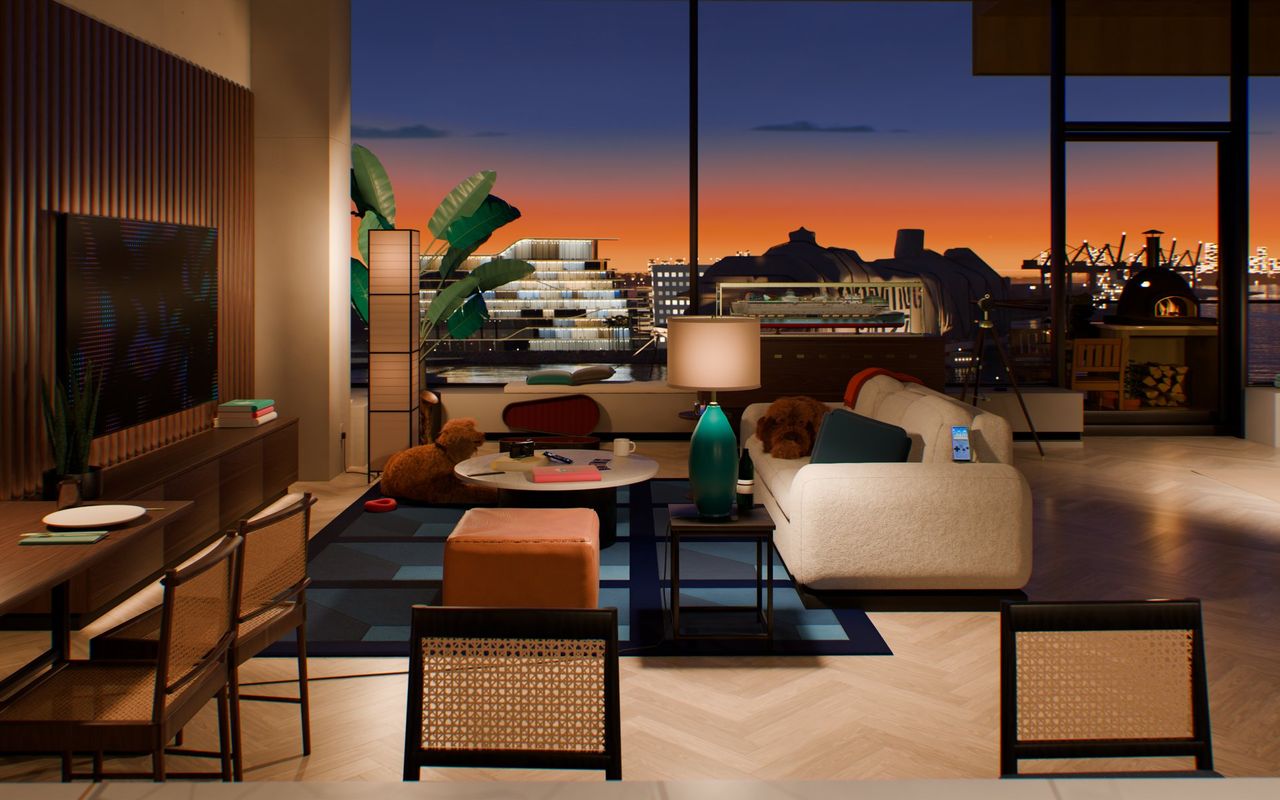
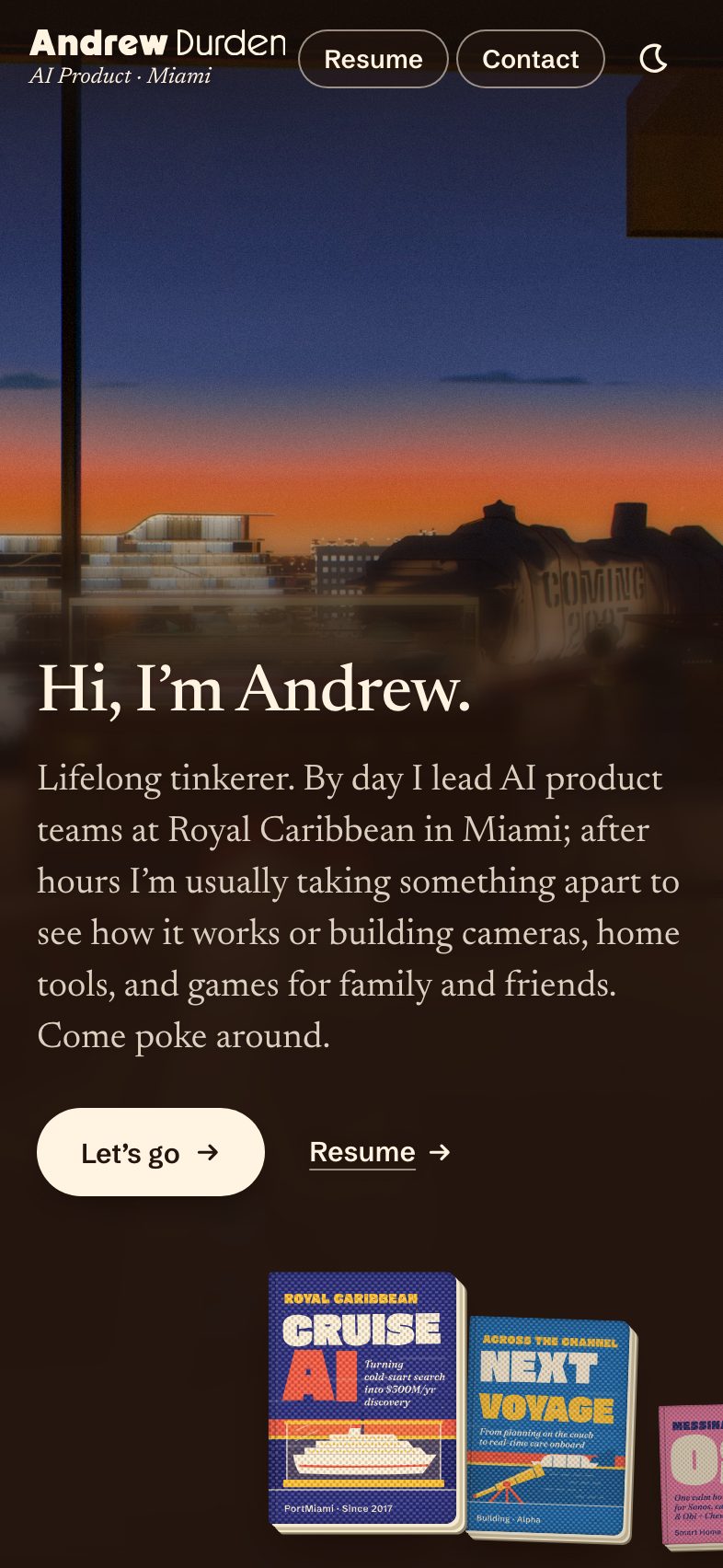
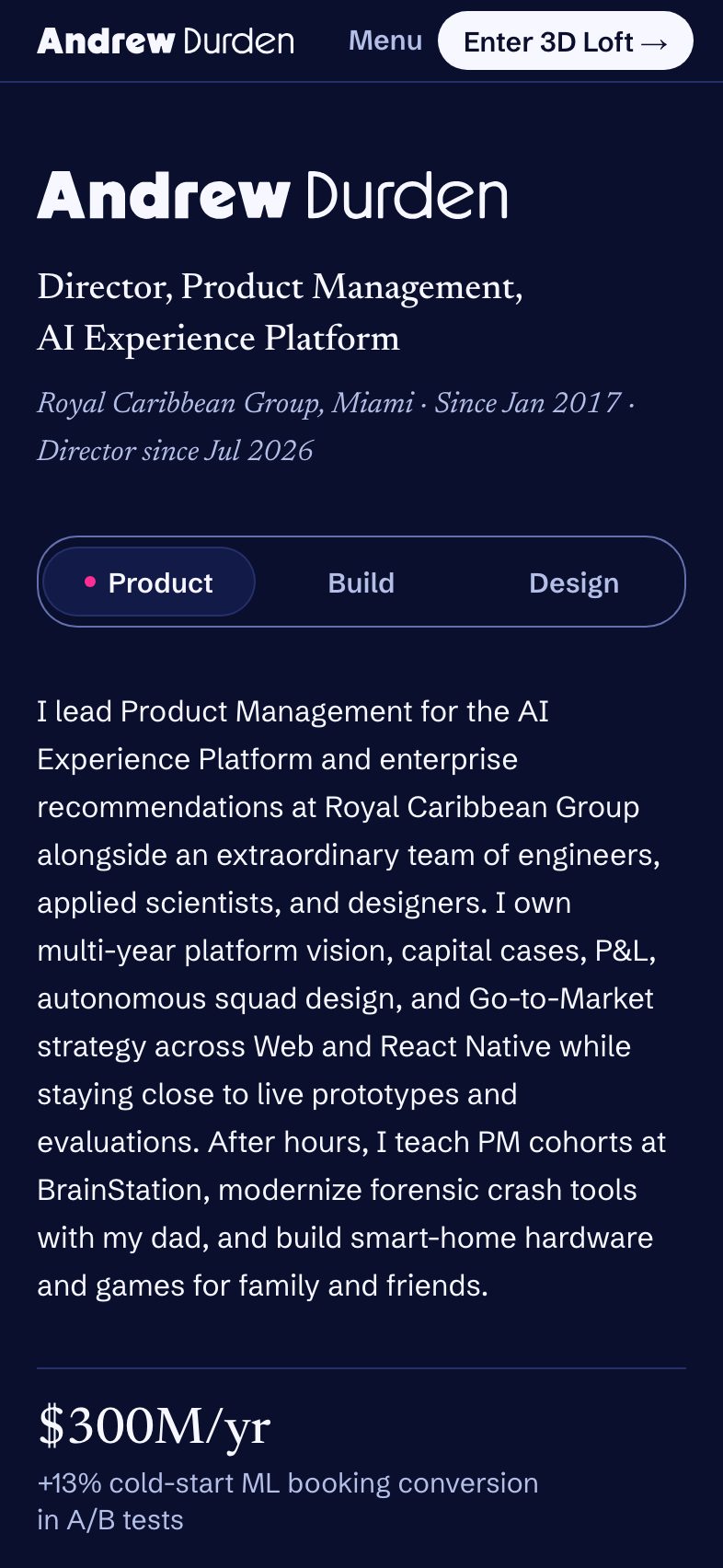
At its core, Home Port is a fast, plain resume page with everything on it, and one photoreal room sitting over the top: an invented Miami loft at dusk looking across the water toward PortMiami. Twelve objects around the room stand in for pieces of my work and my life, each paired with an illustrated cloth-bound book along the bottom of the screen. My line for the room is simple: "Everything in this room was made for someone."
A ship model in a glass case holds the AI, search, and personalization systems I've helped build at Royal Caribbean Group since 2017. A wall TV runs the quiet home interface I'm building for our living room. A workbench holds the highway crash-reconstruction app I'm rebuilding with my dad, and a whiteboard holds my product classes at BrainStation Miami alongside my public SKILL.md playbooks. Even the name pulls double duty: a home port is where a ship is registered and returns, and Miami is both the home port of the ships I build for and where I live.
Where the spark came from
Two people's sites deserve credit right up front.
Years ago, Bruno Simon ruined normal developer portfolios for everyone by dropping a tiny orange truck into a WebGL playground and letting you knock over bowling pins to read about his projects. If you've somehow never driven around bruno-simon.com, go knock over some pins for five minutes. It's pure fun, and it proved a personal site can feel like a place instead of a job application.
The direct spark for how I built Home Port came from Felix Rieseberg and his post Made by mechanical means (along with his follow-up essay, How to be more ambitious, which felt like it was aimed straight at my head). Felix turned his homepage into a 1990s room full of clickable VHS tapes, built with roughly three thousand lines of Python driving Blender in cloud sessions and steered mostly from his phone between bike rides and coffee stops. Go spend ten minutes on felixrieseberg.com too; the Werner Herzog penguin parody tape alone is worth the click.
Watching warm lamp light pool across Felix's desk completely reset my bar for what one person could pull off this way. I wanted to borrow his way of working, while making sure the world itself felt unmistakably like mine.
So early on, my lead session read his post and wrote out a quick "Keep / Change" table before touching a single polygon. We kept the workflow: Python scripts driving Blender in cloud containers, one modular script per part of the room, separate critic sessions, and steering from a phone. Everything on screen changed: warm Miami twilight instead of nineties VHS nostalgia, twelve cloth-bound travel books, pre-rendered path-traced stills instead of a heavy live 3D canvas, and a strict rule that anyone tapping my link inside LinkedIn on a phone had to understand who I am in a second. One row of that table simply said: "Publish how it was made."
Steering from a six-inch screen
I kicked off the first session in the Claude iOS app, and the opening commit landed forty-four minutes later: "Plan the portfolio: the room, the phases, the team". Every cloud session ran inside a modest Linux container with four CPU cores and no graphics card, which turned out to be plenty fast for modeling the room and rendering quick low-sample test shots.
GitHub and Vercel hooked up through connectors, and I attached my other project repositories read-only so the screens inside the loft run my actual apps on sample data instead of fake UI mockups.
I talked to the lead agent the exact way you talk to a sharp coworker when you're away from your desk. When I knew what I wanted, I sent two blunt sentences with the decision up top. When I was still untangling a thought, I hit dictate and rambled while walking the dogs. Whenever I had resumes, notes, or layout critiques from a second AI assistant, I dropped in PDFs and screenshots.
Chat scrollback is terrible once you need to compare visual options, though. Pretty quickly, anything that needed my eyes turned into a small private web page formatted for my phone and backed by its own database:
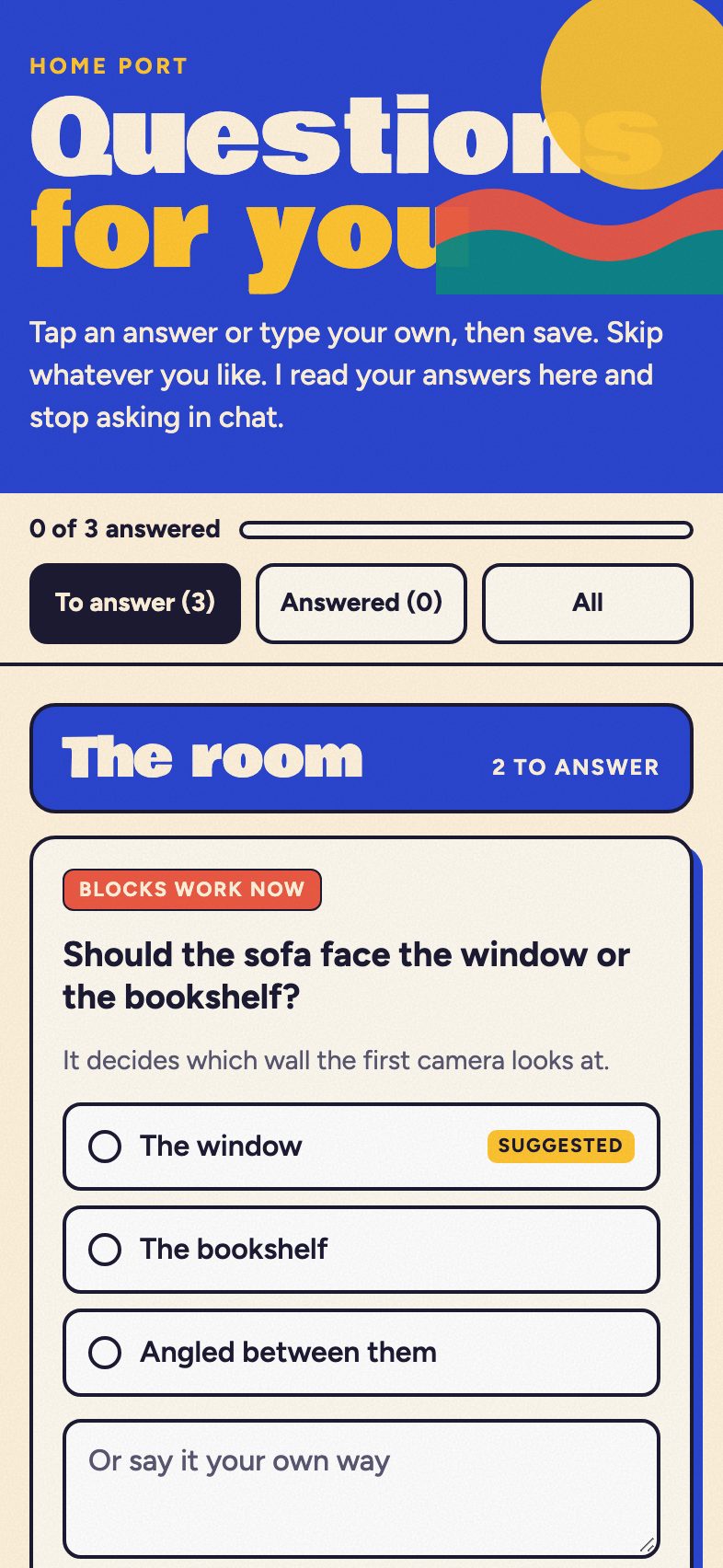
- The questions page: ranked questions with tappable choices, the agent's recommended lean sitting first, and a text box underneath if I wanted to go sideways. I knocked out eleven questions in about four minutes and left a note that stuck for the rest of the build: "That style of questions in that exact same presentation is preferred. It's very easy to be able to extract a lot of information out of me quickly."
- Visual pick sheets: color palettes, typefaces, and room lighting moods mocked straight over a real draft render instead of pitched in paragraphs.
- The camera review sheet: every room angle paired side by side with its book cover and tap-to-zoom, which let me fire off thirty visual notes in seventeen minutes.
- The live room tracker: one status board tracking every prop, lamp, sky pass, and camera with a
"Needs you"filter at the top so I didn't have to babysit chat logs.
Splitting the work so the lead stayed sharp
Early on, one session trying to plan, merge, render, and inspect everything started buckling under its own context window. I sent one message that changed the pace of the whole build: "can we start to have you orchestrating other sessions to conserve your memory? and also to help parallelize?"
Within minutes, a separate integration "desk" session took over branch merges, test suites, and first-pass render checks while parallel builder sessions each took ownership of a single room module. My lead session stopped wrestling build logs and went back to holding my words, the design taste, and the big picture.
If you ever run a multi-day build with coding agents, steal that split immediately. A single thread that writes code, resolves merge conflicts, and reads verbose test output fills its working memory with junk you never needed it to remember. Keeping the noisy plumbing in disposable worker windows kept the lead remarkably sharp across days.
Our division of labor stayed clear too. I wrote the copy and made every call on color, light, framing, and what to cut. The agents wrote the vanilla web code, the nine Python Blender modules, and the deployment scripts.
Overnight Mac renders and a fast plain-text twin
Cloud CPU containers are great for drafting geometry, and hopelessly slow once you want 136 path-traced stills and 42 camera-move clips at 4K master quality.
So I stated the obvious: "there will be a point where maybe locally on my more powerful Mac we leave it running the final frames so we use my local compute power". One worker built a resumable Metal runner for my Mac. Setup took about an hour, and a single caffeinate command ran the high-sample passes overnight, retrying hiccups and pushing finished batches back for the cloud desk to verify.
On the web side, the site ships as plain static HTML and CSS with zero framework weight, locked behind authentication on Vercel during staging before moving onto the domain I've owned for over ten years. Every page also compiles a clean Markdown twin alongside /llms.txt (hat-tip to Eugene Yan) so search crawlers and visiting AI agents can read the whole site cleanly without chewing through room assets.
What stuck with me
If I had to boil down why steering a build this size from a phone didn't turn into slop, it comes down to a handful of habits: tappable visual pick pages instead of chat walls, one dated file of my exact words that no summary could water down, an integration desk keeping noise out of the lead session, cheap browser prototypes before burning GPU hours, and turning every real mistake into a build check the same day it bit us.
The biggest mistake was mine. Early on, I set myself a Thursday launch target. Late one night I finally sent the text I should have sent sooner: "Forget Thursday. build the best experience for mobile and desktop". Once that deadline left the room, the whole build clicked. The phone worked because it stayed a steering wheel, never a tiny keyboard.